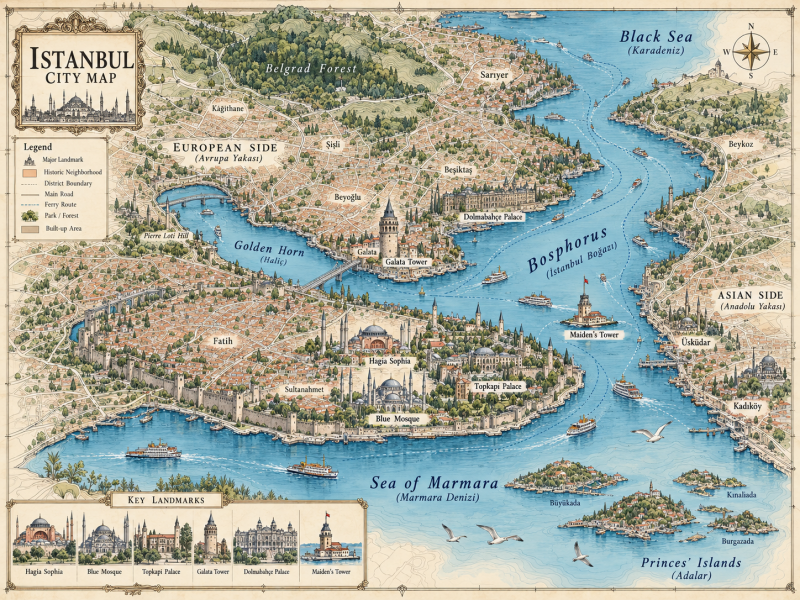
About Istanbul
* These maps are designed to invite you to explore Istanbul from different perspectives. If you wish to visit any of the locations featured on the maps, we recommend using an up-to-date navigation app.
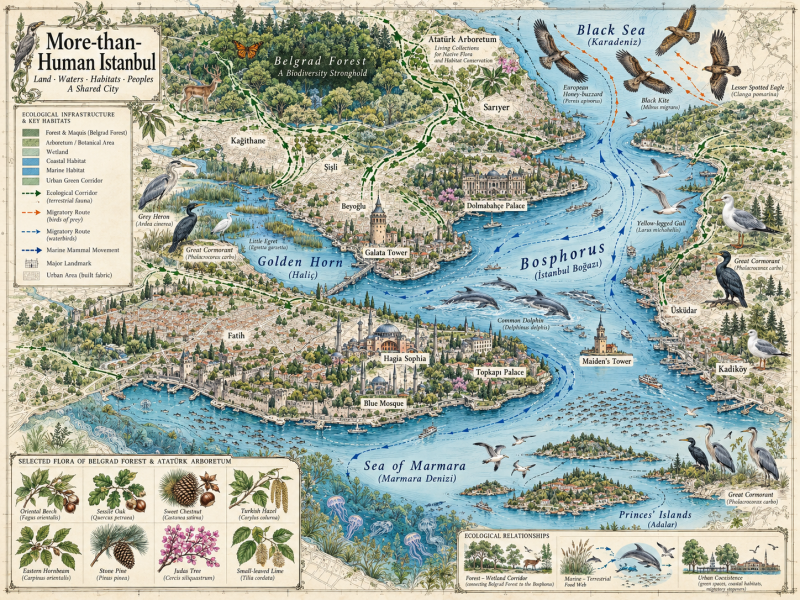
More-than-Human Istanbul
Istanbul is not only a densely inhabited metropolis, but also part of wider ecological networks connecting seas, forests, islands and migratory routes. Its distinctive geography creates encounters between human and nonhuman forms of life within the everyday fabric of the city.
For conference participants interested in exploring Istanbul from a more-than-human perspective, the following places offer opportunities to observe some of these relationships — from dolphins moving through the Bosphorus and migratory birds crossing the city to woodland, coastal and island ecologies.
The Bosphorus — Marine Life in the City
The Bosphorus is both one of Istanbul’s defining urban landscapes and a living marine corridor between the Black Sea and the Sea of Marmara. Dolphins can occasionally be observed from regular passenger ferries and from points along the shoreline.
Where: Bosphorus ferry routes between the European and Asian sides
Look out for: Dolphins, seabirds and the changing relationship between marine life and the urban shoreline
Tip: A regular public ferry journey is one of the simplest ways to experience the Bosphorus as both a transportation route and an ecological space.
Northern Bosphorus — A Migratory Corridor
Istanbul lies on major bird migration routes connecting Europe, Asia and Africa. Raptors and other migratory birds cross the Bosphorus seasonally, making the northern parts of the strait particularly significant for observing large-scale movement across landscapes.
Where: Northern Bosphorus / Sarıyer area
Look out for: Raptors and other migratory birds, depending on the season and weather
Belgrad Forest — Woodland Istanbul
Belgrad Forest offers a very different experience of Istanbul. Located on the European side, it contains woodland dominated by species including oak, beech, hornbeam and chestnut, together with streams and historic water infrastructure.
Where: Bahçeköy / Sarıyer
Look out for: Woodland vegetation, birds, forest habitats and historic reservoirs
Good for: Walking and experiencing a landscape that contrasts strongly with central Istanbul
Atatürk Arboretum — Trees, Observation and Knowledge
Located beside the wider Belgrad Forest landscape, Atatürk Arboretum brings together collections of trees and other woody plants for scientific research, observation and education.
Where: Bahçeköy / Sarıyer
Look out for: Diverse tree species, ponds and seasonal changes in vegetation
Princes’ Islands — Island Ecologies
The Princes’ Islands form an archipelago in the Sea of Marmara, reached by public ferry from both the European and Asian sides of Istanbul. The inhabited islands combine coastlines and wooded landscapes with long-established human settlements and historical architecture.
Where: Büyükada, Heybeliada, Burgazada and Kınalıada
Look out for: Coastal landscapes, vegetation, seabirds and the relationship between island settlement and nonhuman environments
Getting there: Public ferry
Encounters Along the Way
More-than-human Istanbul does not necessarily require travelling to a designated nature reserve. Many encounters take place within the ordinary rhythms of the city.
While travelling through Istanbul, participants may notice:
- seabirds following ferries and fishing along the shore;
- cormorants and other waterbirds around the Bosphorus and the Golden Horn;
- dolphins occasionally surfacing beside commuter ferries;
- trees, birds and other forms of urban life inhabiting parks, gardens and neighborhood streets;
- the continuous movement between terrestrial, marine and urban environments.
These everyday encounters offer another way of approaching Istanbul: not simply as a human city, but as a shared and constantly negotiated habitat.